
A Full-Stack Labour Day Power Review
Including an outlook to swap values if things continue this way.

We go from fundamentals to a view of flows and how they link to the cross-border political backdrop, then continuous Intra-Day and adjustment-risk analysis, ancillary activations, including an analysis of regional differences, then to the frequency dynamics, before taking a step back to reflect on the value of variability swaps using Labour Day as an opportunity to re-calibrate expectations. As ever, let me know if you spot mistakes, disagree with something, or simply to develop the conversation. You know where to find me.

We move from preview to a review, which reminds us that ‘whatever has the nature to arise, will pass away.’ Eventually, certainly. If you preview, you must review. “Always follow up,” I tell myself.
The labour movement knew the power of follow-up, but its point was to win the right to stop. There’s some danger in my little maxim: every loose end can become a summons, every unanswered email a moral debt, every task a tiny foreman. So, follow up enough, but let some things pass. Work needs diligence, but life needs some drift.
What we’re doing here isn’t work, however. Work is what you do for others, art is what you do for yourself as Franz points out in Sondheim’s play on Seurat. Following the power markets together is a pursuit, a challenge, a drifting conversation, supported by the new systems we now have to help us explore.
Our use of these systems to explore the energy context can be seen as an exploration of a fundamental question: how can or should we calibrate the exploration of our interests, be they at work or in ‘art’ or leisure, to the shockingly quick development of the new technology?
“I think for the actual mental load of being a person, interacting with these systems is going to be quite strange. I already find that I’m like: Am I keeping up with the ability of these systems to produce insights for me? How do I structure my life so I can take advantage of it?” Jack Clark
When in doubt, we must always come back to reflect on whether we are having ‘fun,’ the definition of which is, of course, highly personal.
“It’s hard to compete against someone who’s just there to have fun.” Peter Steinberger
Now that we’re wound up, let’s review Labour Day in full. It’s such a useful and important example, calibrating us to the season and the times ahead.
The generation profile, imports/exports;
DA expectations vs ID actuals;
Ancillary activations;
The value of variability swaps if May-day extremes continue.
For context and to explain why the example is so important, consider the discourse around the energy situation we find ourselves in. It’s worth tracking the full range of arguments and perspectives: cheap renewables, missing flexibility, market coupling, consumer opportunity, grid stress, political point-scoring, various agendas.
The situation is highly charged. Some perspectives are well developed, some seem too quick. In either case, it’s more important than ever to develop the conversation responsibly, productively.
“Symptom von zu wenig Flexibilität im Stromnetz und zu wenig Speicherkapazitäten,” Windkraft-Journal
“schaltet morgen eure PV-Anlage ab,” Lion Hirth on LinkedIn; “vom Lastfluss über Spannung bis hin zur Systembalance,” NIUS, quoting Lion Hirth; “mehr Strom [im] Netz… als wir abnehmen können,” Lion Hirth on LinkedIn
“Duitse producenten gaan dan proberen om hun stroom bij ons te slijten,” ANWB Energie
“Price drops are not limited to Belgium,” The Brussels Times / Belga
“více elektřiny, než se stihlo spotřebovat,” FXstreet.cz, reporting Bloomberg
“Deutschland Geld ins Ausland zahlt,” AfD Bundestag press release. For a very interesting wider debate see also: Philipp Man’s challenge to Daniel Stelter.
“Risiko eines Brownouts,” Apollo News or “was die Energiewende bringen kann und wo es hakt,” Golem.de, etc. etc. etc.
Hirth’s intervention is narrower than many of the more politicised perspectives. The argument is not that solar is the problem. It is that a large volume of small, weakly controllable PV is unhelpful when demand is low, prices are deeply negative, and system margins are already compressed. That is a flexibility and controllability problem, not a reason to flatten the whole debate into a verdict on renewables.
So, given this starting point, consider the fundamentals. (Please excuse the gaps in the load data, which are from the source. You may have noticed the same on Energy Charts.)
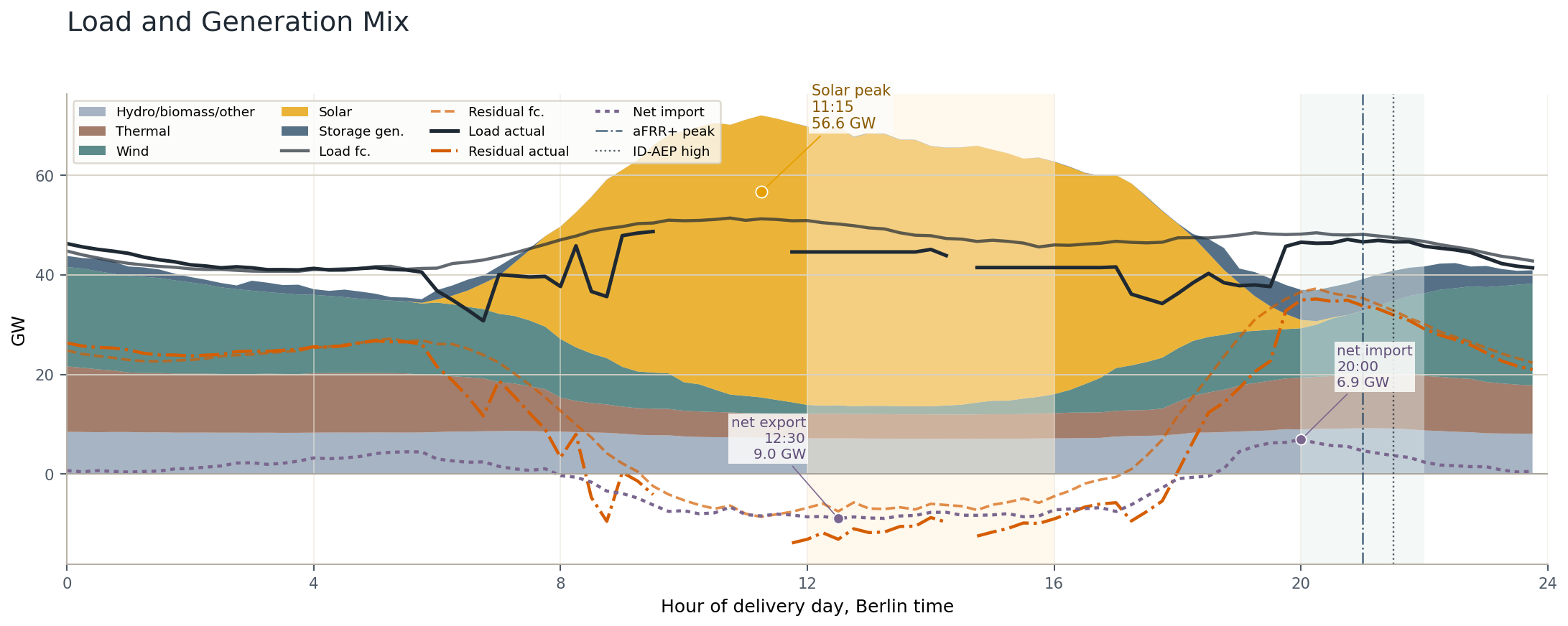
Solar peaked at 56.6 GW around 11:15 Berlin time. Net exports peaked at 9.0 GW around 12:30; by the evening the line had flipped to net imports, peaking at 6.9 GW around 20:00. This helps explain why, as we will see later, aFRR- activation was fairly small: the midday surplus was expected and fed through into negative prices and net exports, rather than as a large national downward-balancing activation. The activation event came later and in the other direction.
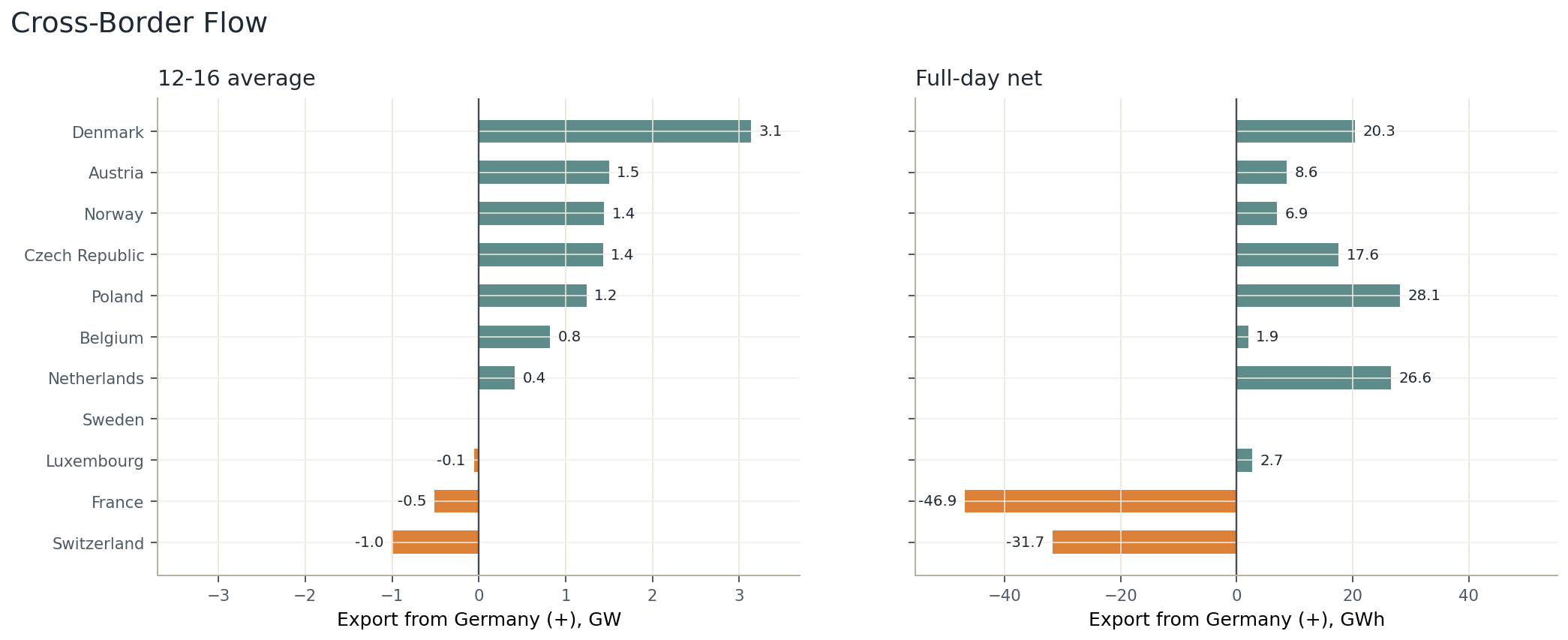
The 12-16 export block went mainly towards Denmark, Austria, Norway and the eastern borders. At the 12:30 export peak the leading destinations for German flow were Denmark 3.1 GW, Austria 1.5 GW, Norway 1.4 GW, Czech Republic 1.0 GW. Over the full delivery day, the net export balance was led by Poland 28 GWh, Netherlands 27 GWh, Denmark 20 GWh, Czech Republic 18 GWh, while Germany was a net importer from France 47 GWh, Switzerland 32 GWh.

It’s important to monitor these cross-border flows, because power transmission creates political linkage too. Remember Norway? In Norway to Texas via Yunnan, I., we saw how cross-border electricity integration can turn someone else’s energy transition into your domestic politics. That has not gone away.
“Use May 1st to make clear your opposition to the EU’s overriding of Norwegian energy policy. Demand national control over power. Norway needs industry!” Nei til EU Vestfold; “utenlandskabler til Tyskland og Storbritannia ... import av europeiske strømpriser,” Nei til EU Vestfold
“no to new electricity interconnectors,” regjeringen.no; “does not want Norway to align itself more closely with the European energy system,” regjeringen.no
“Strømprisene har vært usedvanlig høye i første kvartal,” Teknisk Ukeblad / NTB, citing NVE
“redusert etterspørselsrespons,” Finansavisen / DNV authors
In some places at least, Norwegian arguments about interconnectors hardened into Labour Day language about national control, industry and imported European prices. While our pivot point here is Germany, we must develop the wider European context. Physical flow feeds into political flow.
So, moving back to our central pivot, let’s focus in further on the day. How did the fundamentals play out in the markets? How can we take Labour Day as a prompt to think about the ‘job’ of flex and the expected values of variability swaps?
