
Negative prices, at a cost?
Oversupply, operating costs. An example from GB. Part I.

Negative electricity prices generate a reliable stream of social media reflection: plots of negative price hours are popular, as are broad statements on negative price hours and market efficiency.
Are negative market prices a problem? No, the market is incentivising flexibility!
What lies behind negative price plots and broad statements like this?
Electricity might be understood as something like a fictitious commodity. The market lies at the surface of a complex system of grid operation, regulation and collective cost recovery. Electricity supply is part of the social contract. Reliable supply involves costs of balancing supply and demand, managing transmission constraints and keeping frequency, voltage and network flows within safe limits. These costs are not necessarily visible in the wholesale price.
How sure are we that negative prices are not a problem from a broader system perspective?
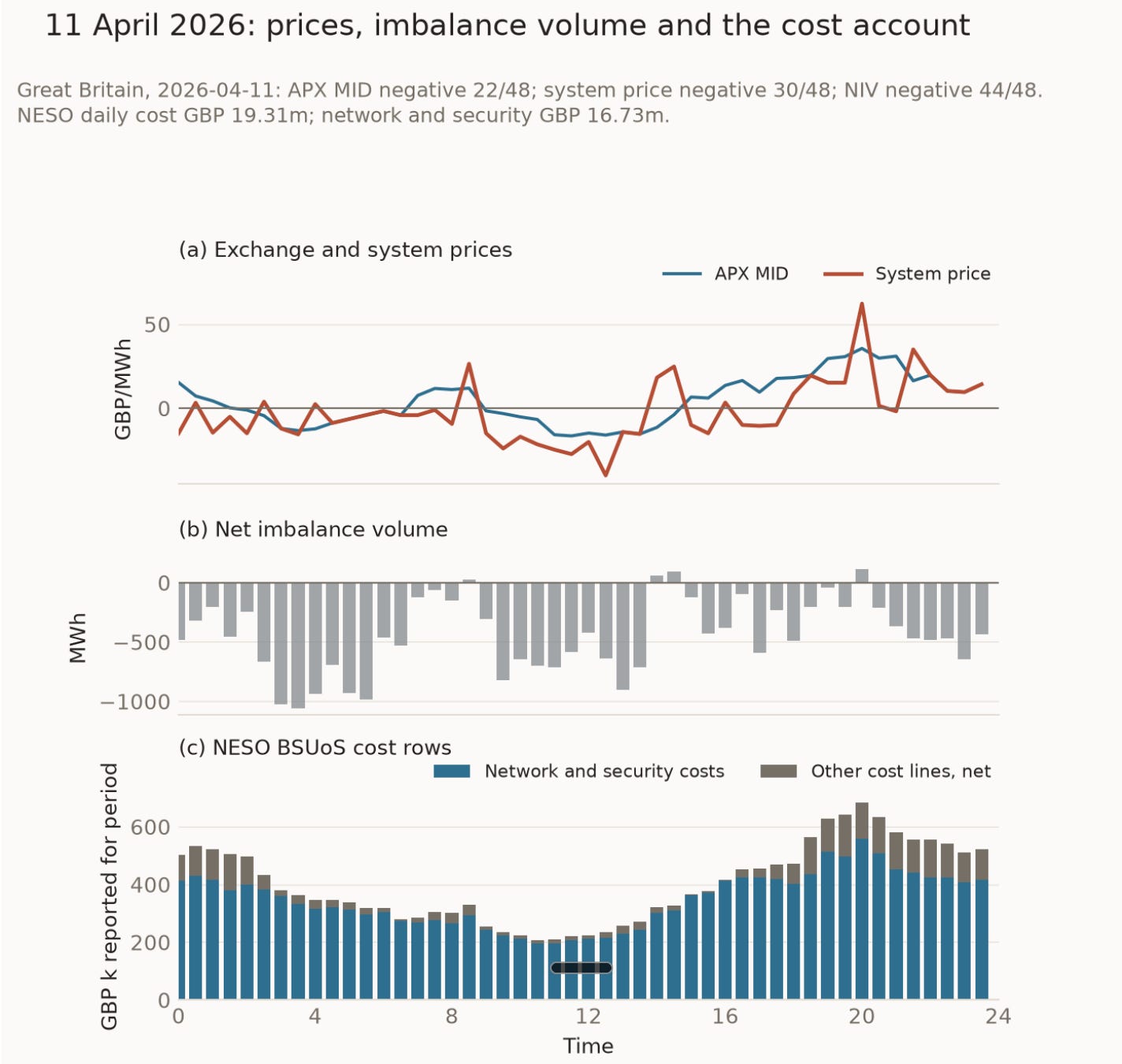
While exploring the GB market, an AI agent suggested 11 April 2026 as an interesting day for further study. Britain’s system price was negative in 30 of 48 half-hours. NESO nevertheless recorded £19.31 million of operating costs, including £16.73 million in its constraint-cost category.
We are motivated by a need for better ‘situational awareness.’ Where are the limits to what we know?
The more we know, the more we know that we don’t know, the less we are likely to make sweeping statements. Griffin seems to have understood the limits better than Aschenbrenner, for example.
In recent months we’ve developed our coverage from Germany to Czechia and CAISO, with brief tours to Austria, Italy and GB. There’s something to learn from every electricity system. It’s not about getting to a ‘truth’ — what’s the use of truth, anyway? It’s about the need for a fuller picture.
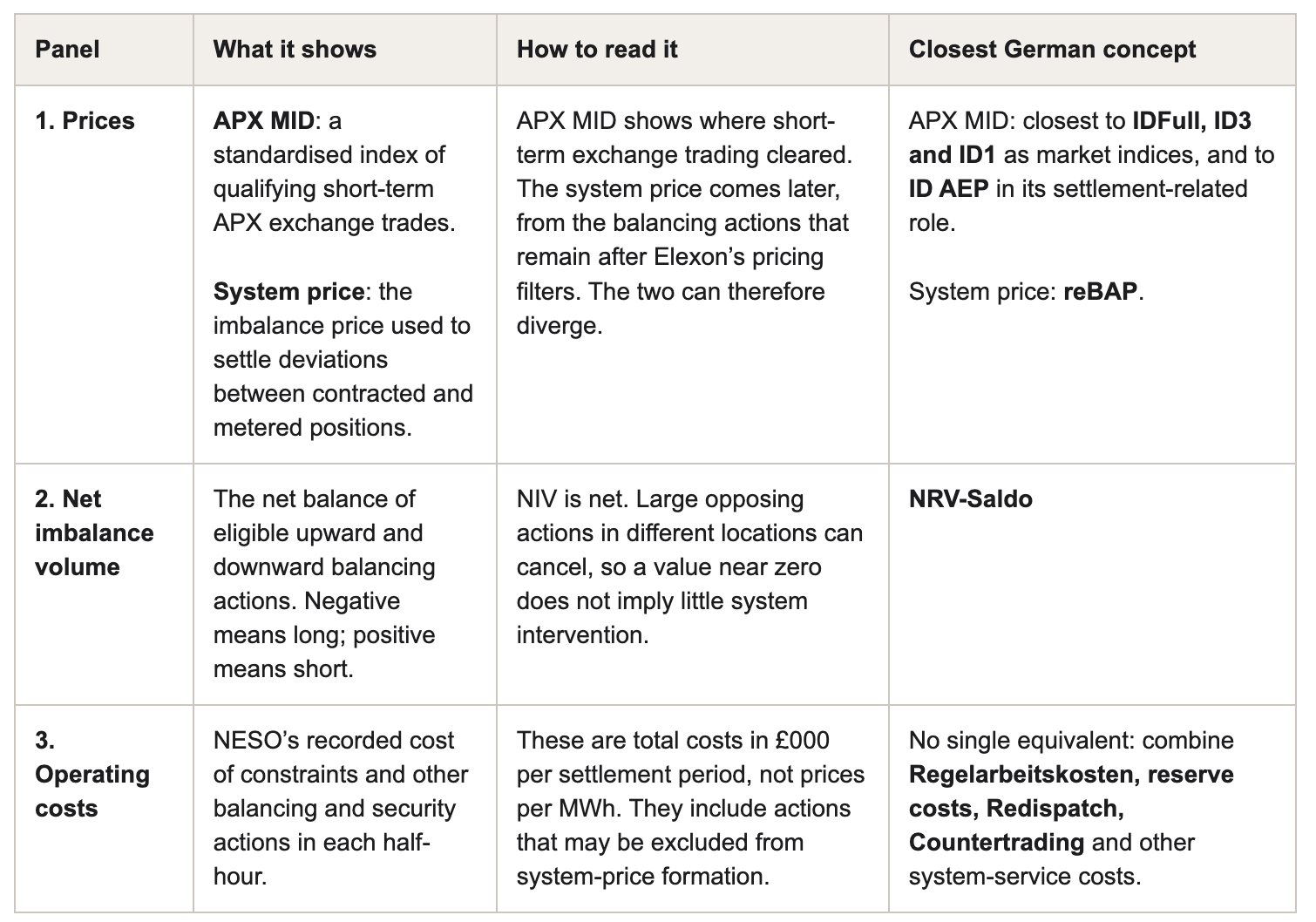
It is the availability of Operating Cost data (Panel 3 above) that makes GB a system in which we can follow the consequences of negative prices beyond the price itself.
Germany has no directly comparable dataset. A partial account could be assembled from balancing-energy data, reserve procurement, Redispatch volumes and monthly cost accounts. Let me know if you know how.
Perhaps the absence of a consolidated cost view helps narrow the perspective of the German Kommentariat. The recommendation is to travel more—by subscribing to this newsletter, for instance.
