
El Niño to enspired
Weather, wires, reserve prices, French nuclear, and the search for readable flexibility signals.

Welcome to the weekly update where we review what is going on in the energy markets, and in the industry. El Niño is in the news, and I was particularly struck by the Washington Post’s look back at 1877-78. What can we expect? Imagine a long, long stretch of high-PV days across Europe. What would be the consequence, from Euphemia to river water temperatures in France? Also, enspired published its index values with a change in methodology. That takes us to a short reflection on ecosystems and strategy. Complete list of sources at the end.
Solar pressure, wet/cloud softness, wind and forecast risk, border flows, and the evening handover after PV fades… the weather moves us through a range of different patterns. Let’s count. Since the start of May we’ve had 2 clear/high-radiation days, 5 wet/cloud days, 2 wind/cool days and 4 mixed days.
To clarify: Clear/high-radiation means shortwave radiation above 20 kWh/m2 with limited cloud and little rain. Wet/cloud means either material rain or very high cloud with low radiation. Wind/cool means maximum wind speed above 22 km/h with average temperature below 10 degrees C. Entirely arbitrary but useful distinctions.
What were things like this time last year? Skip this if you’re not following the markets daily… May 2026 has a DA average around EUR 97/MWh compared with EUR 68/MWh over the same first thirteen May days in 2025. The average DA high-low range is EUR 204/MWh, versus EUR 179/MWh last year. FCR 12-16 is averaging EUR 244/MW/4h, above both the same 2025 window at EUR 213/MW/4h and the 2026 year-to-date average of EUR 118/MW/4h. aFRR- 12-16 is about EUR 327/MW/4h equivalent, close to the same May window in 2025 but well above the 2026 year-to-date average of EUR 138/MW/4h equivalent.
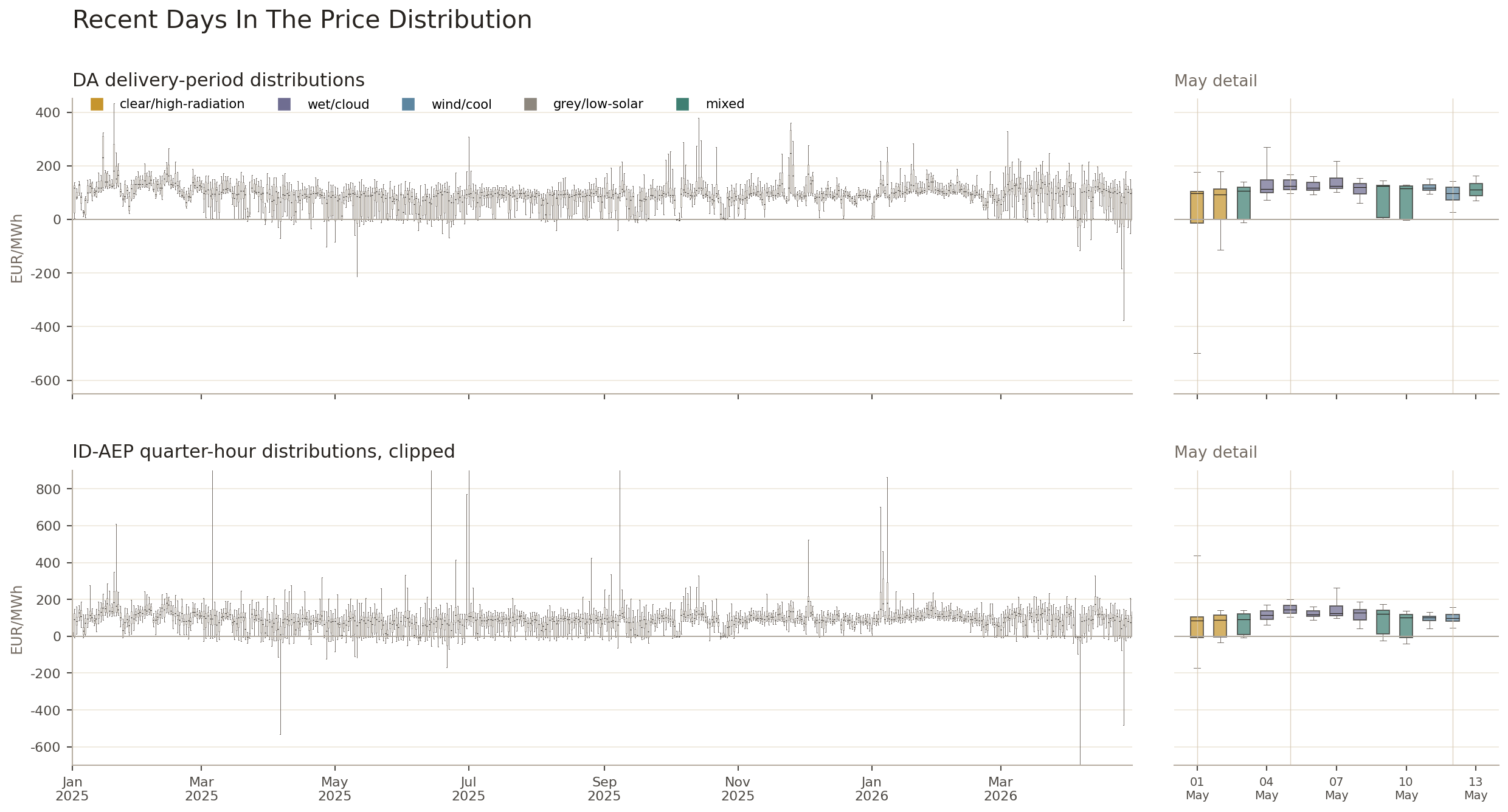
The May detail shows a low-price spring shape that keeps changing character. Clear days do not automatically become negative price risk events. Wet/cloud days can calm the DA lower tail while reserve capacity remains firm. Wind/cool days move the focus toward residual load and forecast error.
On the realised intraday side, May 2026 is not far from last May on the average readout: SPARX is running around EUR 363/MWh for the complete days through 12 May, versus EUR 367/MWh in the same 2025 window. The ID-AEP daily range is similar too, around EUR 444/MWh versus EUR 455/MWh. The difference is less the average realised range than the way reserve prices remain elevated while the weather keeps moving between regimes.
Thinking about forecasts
"Lovely day, isn't it?", "Can you believe all this rain?", "How about this weather?" Polite, innocuous conversation, you might think. Nein! The weather is a serious matter, particularly in Germany: a ‘lovely’ mix of shortwave radiation and cloud cover translates to complex PV expectations; wind becomes generation and forecast-error risk; temperature becomes load; rain and river conditions become hydro, cooling and availability questions. Those expectations then interact with residual load, grid constraints, reserve procurement, cross-border capacity and trader positioning. Prices trace these interactions as do flows, activations and frequency deviations.
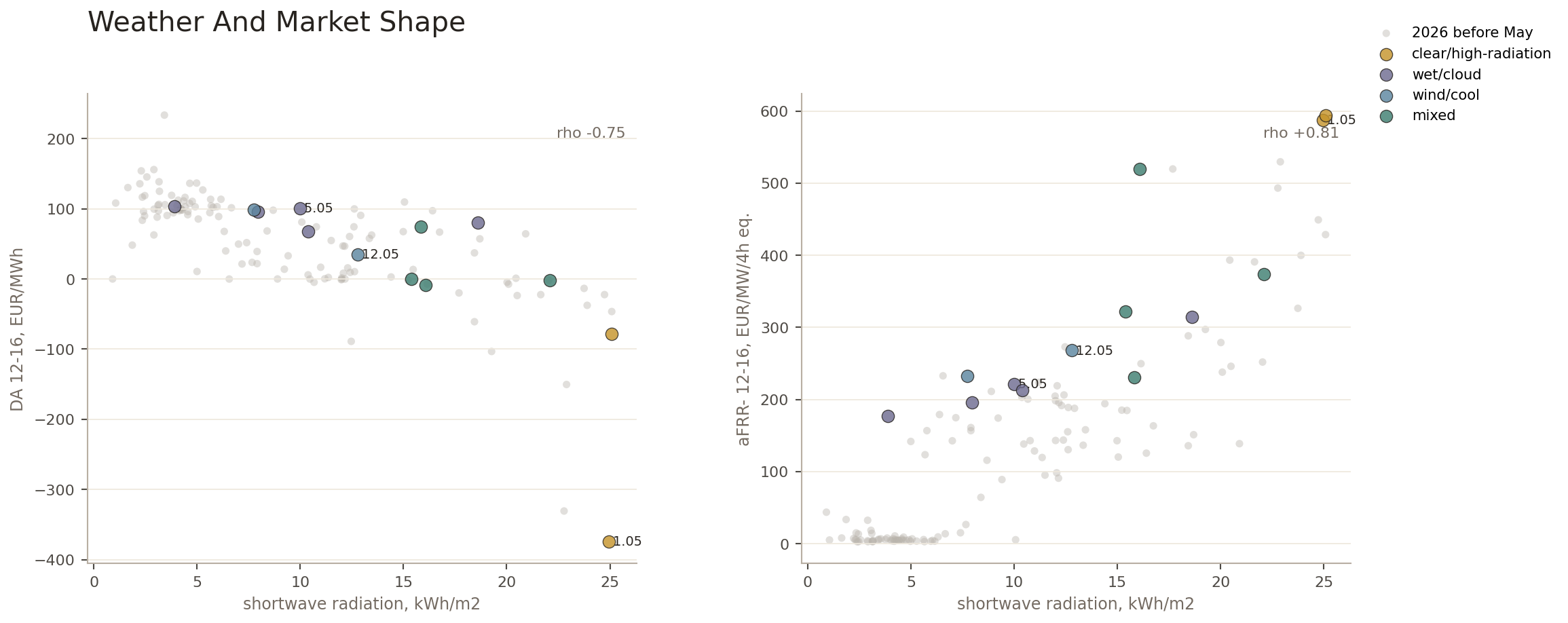
Shortwave radiation has the relationship with midday DA price that you’d expect. Reserve prices also move with the weather, but not as the same signal: the scatter and the exceptions are where it gets interesting
Open-Meteo deserves a bow here. Patrick Zippenfenig’s project takes open numerical-weather data from services such as DWD, NOAA, Meteo-France, ECMWF and others, processes more than 2 TB of model data per day, and exposes it through a no-key JSON API.
Please show your support by signing up to the open-meteo Substack, which is relatively inactive at the moment, unfortunately, but who knows what the power of new subscriptions might lead to! The source code is public. Open infrastructure in the best sense: quiet, useful, inspectable. Kudos, Patrick Zippenfenig!
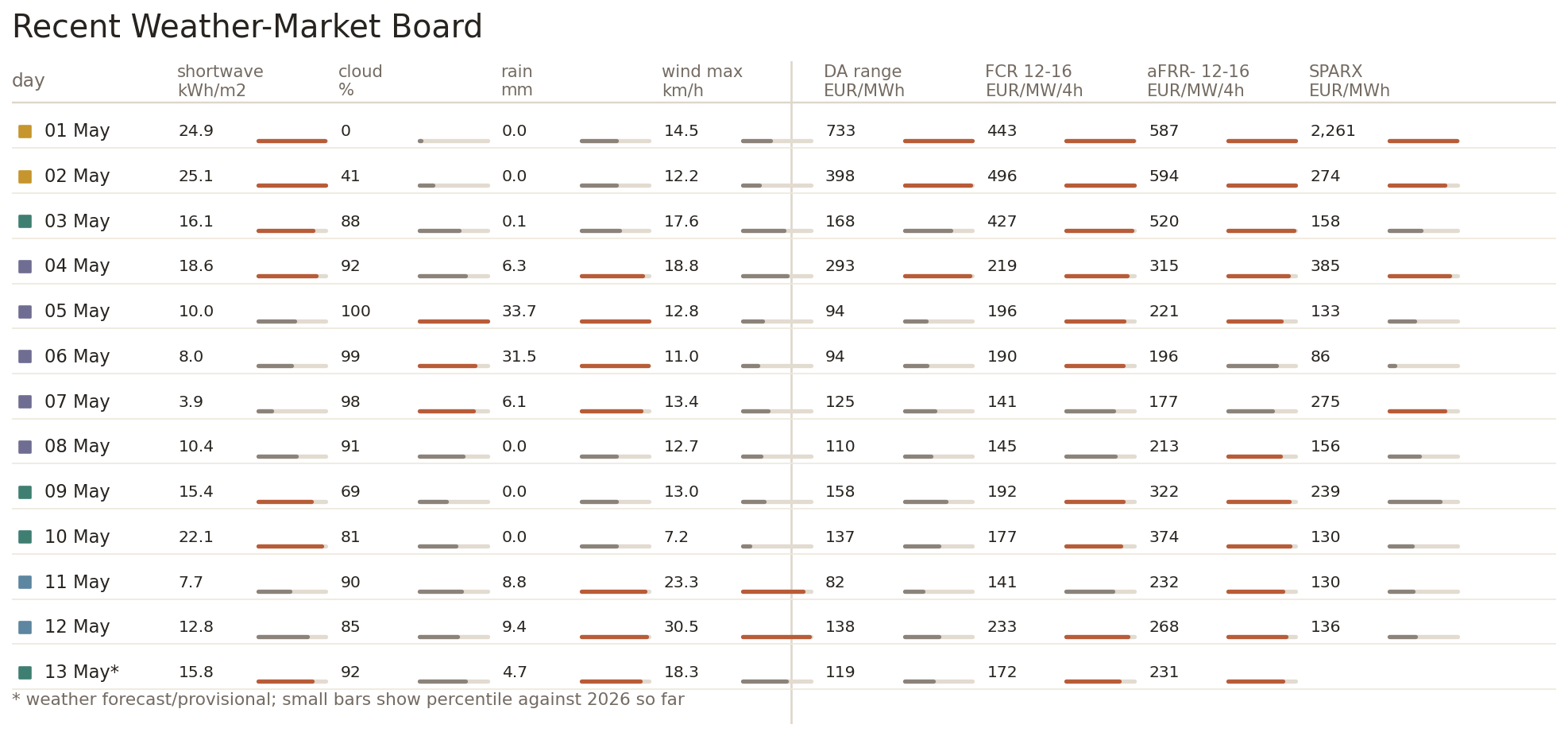
The recent run of the weather and the corresponding energy situation is mixed and rich. The system has several routes into tension. Three hypotheses you might like to have in mind:
