
Corridors of power
Exchange to schedule to physical flow: it’s a complicated journey

On our way from Germany to Italy via Austria, let us follow the transmission corridor in two dimensions: first price, or what the market cleared at in EUR/MWh; then flow, or how much power was scheduled or physically moved in MW.

Along the way, let’s learn about the market structures through which those prices and flows are produced.
1. Market zones: virtual borders
Let us begin with the virtual borders of the day-ahead market: the wholesale prices cleared in each zone.
Germany DE-LU day-ahead bidding-zone price
Austria day-ahead bidding-zone price
Italy NORD MGP zonal price
Italy CSUD MGP zonal price.
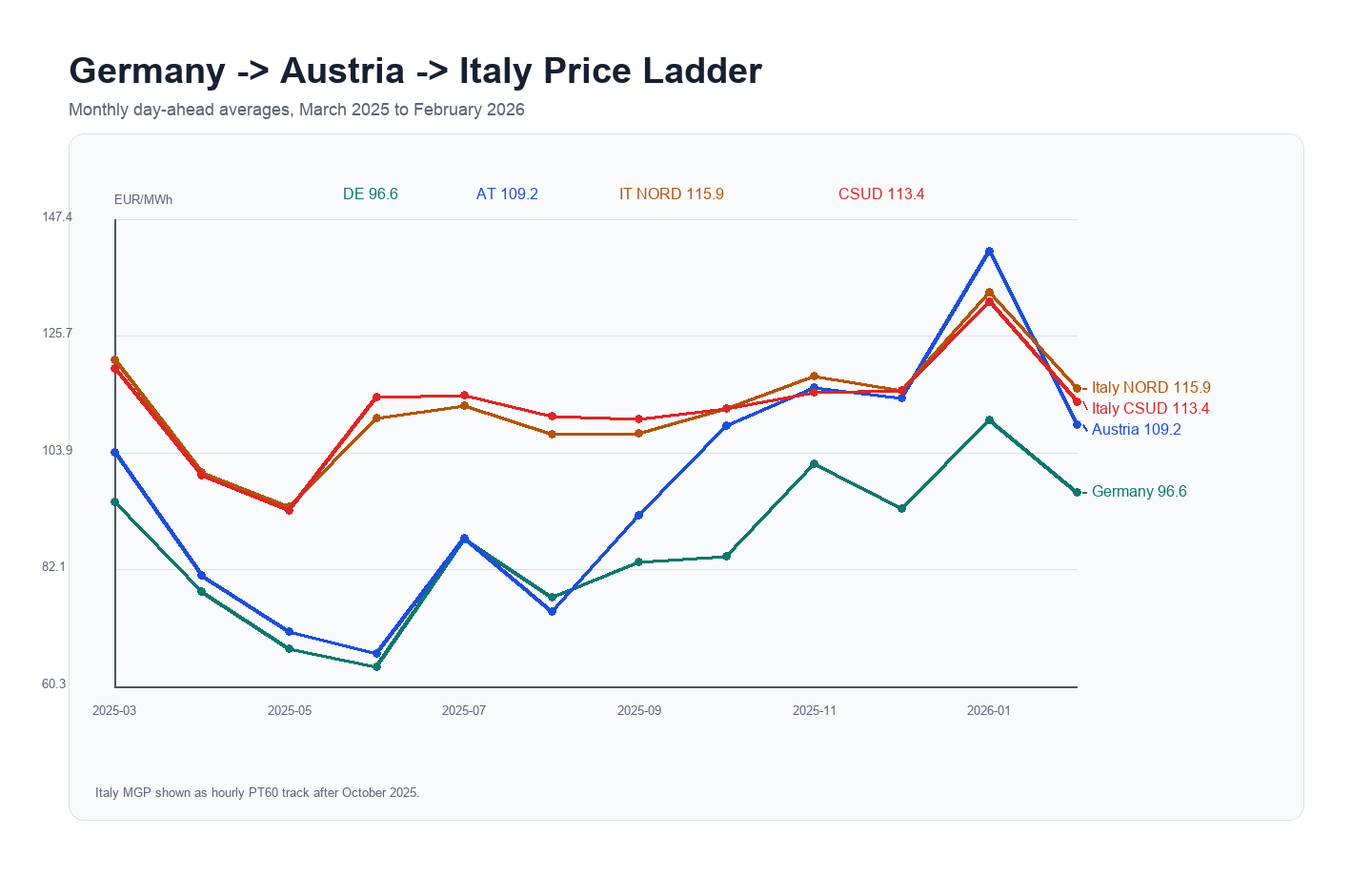
Germany is the low ‘anchor.’ Austria usually sits above Germany, and Italy NORD above both.
Across the year, the average of the monthly observations is 86.57 EUR/MWh for Germany, 97.17 EUR/MWh for Austria, 112.40 EUR/MWh for Italy NORD, and 112.56 EUR/MWh for Italy CSUD. (As ever, let me know if you have different numbers, I’m leaving the comfort zone here.)
What looks at first like a simple staircase from Germany to Austria to Italy should reflect how fuel mix, grid constraints and market design shape prices inside an “integrated” Europe.
1.1 Price Differences
Germany’s lower average reflects a system more exposed to renewable-heavy low-price hours. Austria then tends to sit above Germany because cheap northern power does not move south without friction, especially since the 2018 split of the German-Austrian bidding zone introduced formal congestion management at that border.
Italy NORD sits higher again because gas still sets the marginal price more often. In its 2024 annual report, GME says combined-cycle gas was the price-setting technology 61.4% of the time and that Terna’s generalised northern-border constraint mechanism was activated in 21% of hours. Read that way, the gap is not just “Italy is expensive”; it is also the visible effect of transmission bottlenecks along a corridor where geography still matters.
1.2 Loopy Travels
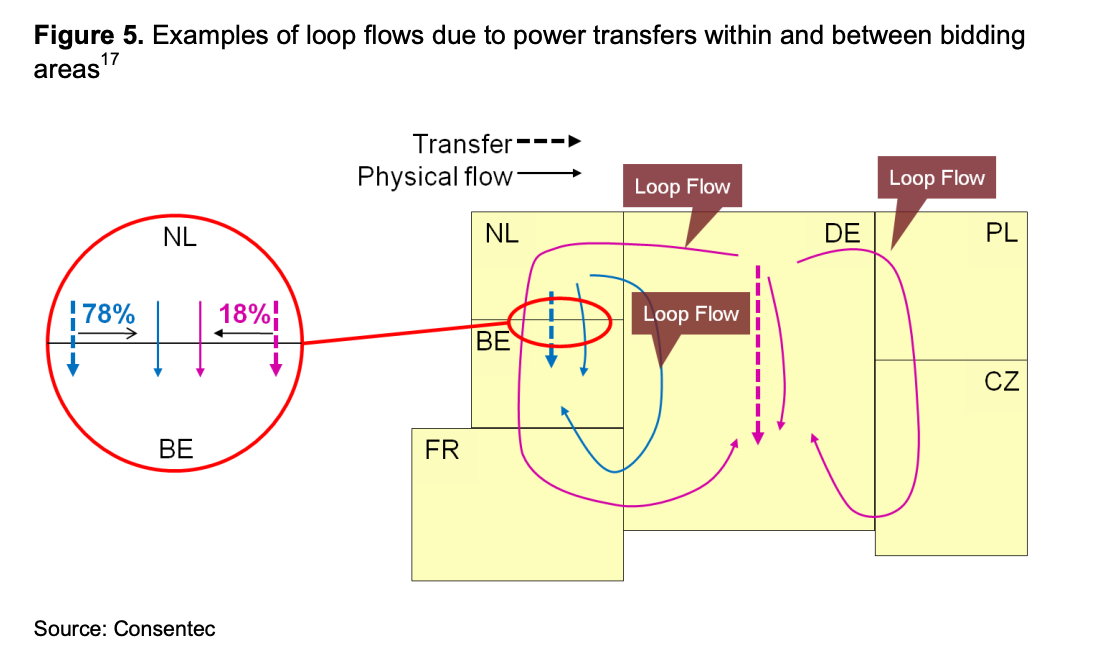
Looking at all of this I came across the concept of ‘loop flows.’ In a meshed AC grid, commercial trades and physical paths do not line up neatly and ENTSO-E defines a loop flow as a physical flow whose source and sink lie in the same zone, even though the line used lies in another.
A long-standing BNetzA/Frontier-Consentec study illustrates this with north-south German transfers spilling through neighbouring countries. So, part of the corridor can already be physically “used up” before the market gets to allocate it commercially. Does this help explain why German, Austrian and Italian prices can diverge even in a coupled market?
This also echoes the German bidding-zone debate. Does it still make sense for Germany to remain a single zone? A split would change what counts as “internal” and what counts as “cross-zonal,” forcing more of the north-south bottleneck to appear directly in prices and capacity allocation instead of being pushed downstream into redispatch, cross-border distortion and recurring argument about inefficiencies and spreads. In its 2025 bidding-zone study, ENTSO-E said all studied German-Luxembourg split configurations improved economic efficiency, with a five-zone split scoring highest.
Are dynamic grid fees the answer, or merely a sticking plaster over inefficiencies created by a single large zone? BNetzA is very seriously exploring more dynamic network tariffs to reward flexible behaviour. Arguably that sits at a different layer of the problem. Dynamic fees can sharpen local incentives. They do not replace the wholesale task of locating structural transmission scarcity more in prices.
