
Compare and Contrast: Who Owns the Battery, Who Owns the Volatility?
From Drax’s physical tolls and Flower–ENGIE’s virtual FPA to Gresham’s revenue floors and Fortinbras’s TBx swaps, a market for differentiated BESS claims is emerging.

Increasingly, the European BESS market is structuring separate claims on ownership, control, minimum revenue and power-price volatility.
In January 2024, TotalEnergies agreed to acquire Kyon Energy, including its development team and a German battery pipeline extending from operating projects to ready-to-build assets.
Just over two years later, TotalEnergies agreed to sell Allianz Global Investors a 50% stake in eleven Kyon-developed projects totalling 789 MW / 1,628 MWh.1
TotalEnergies retained the other half and remained the operator. A syndicate of ten financial institutions subsequently provided approximately €440 million of debt, supported by what the lenders described as “structured tolling arrangements.”2
The same separation is appearing in other forms.
Flower recently entered into a seven-year virtual flexibility purchase agreement with ENGIE.
Drax acquired long-term dispatch rights over large British batteries.
Gresham House contracted revenue floors while retaining exposure to merchant upside.
Fortinbras Asset Management says its VOLTAL strategy takes battery-linked power-price volatility through TBx swaps creating a “[u]nique source of uncorrelated alpha via novel risk premium.”
From capital recycling to risk circulation
The first phase of European BESS was dominated by project formation: grid connections, land, permits, development capital, equipment, construction and market access. Those tasks remain essential, especially where regulatory uncertainty is high.
Another set of processes is developing around the asset class.
Risk transfer changes who bears some part of uncertain battery revenue through a toll, floor, FPA or swap.
Capital recycling replaces part of the sponsor’s equity with institutional co-equity, debt or disposal proceeds.
Risk syndication aggregates those exposures across assets, markets or countries and places them with another pool of capital.
These processes are particularly interesting when they occur together. Let’s have a closer look.
Europe’s BESS risk-transfer rankings
The following tables present the publicly announced transactions identified in this review through 22 July 2026.
We will distinguish between the following structures.
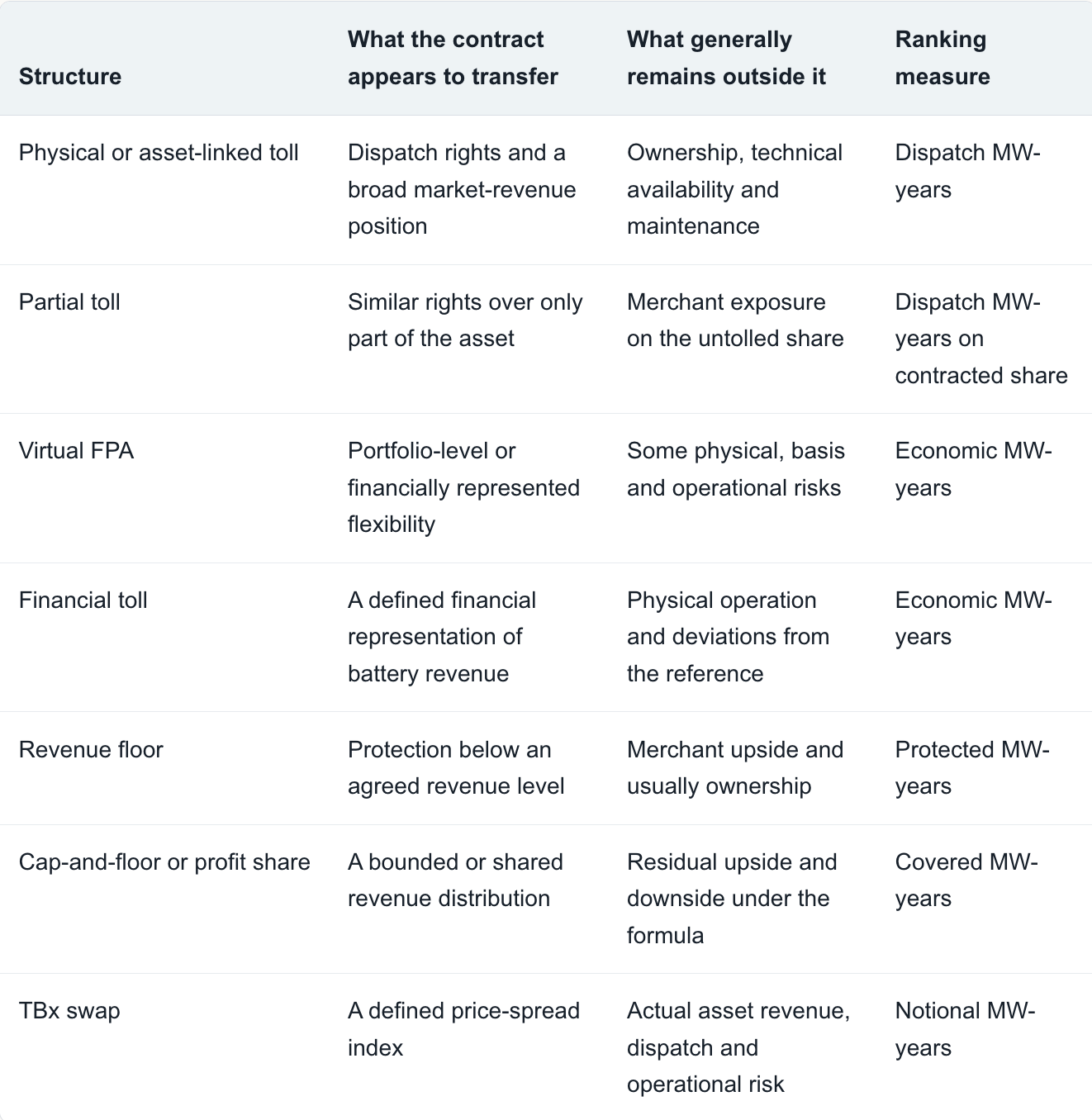
Ordinary optimisation mandates are excluded unless the optimiser or counterparty also appears to provide a fixed payment, floor or other material transfer of revenue risk.
We will use MW-years wherever we can to weight size as well as tenor.

Ranking 1: Asset-linked physical and partial tolls
*Based on publicly available source data.3
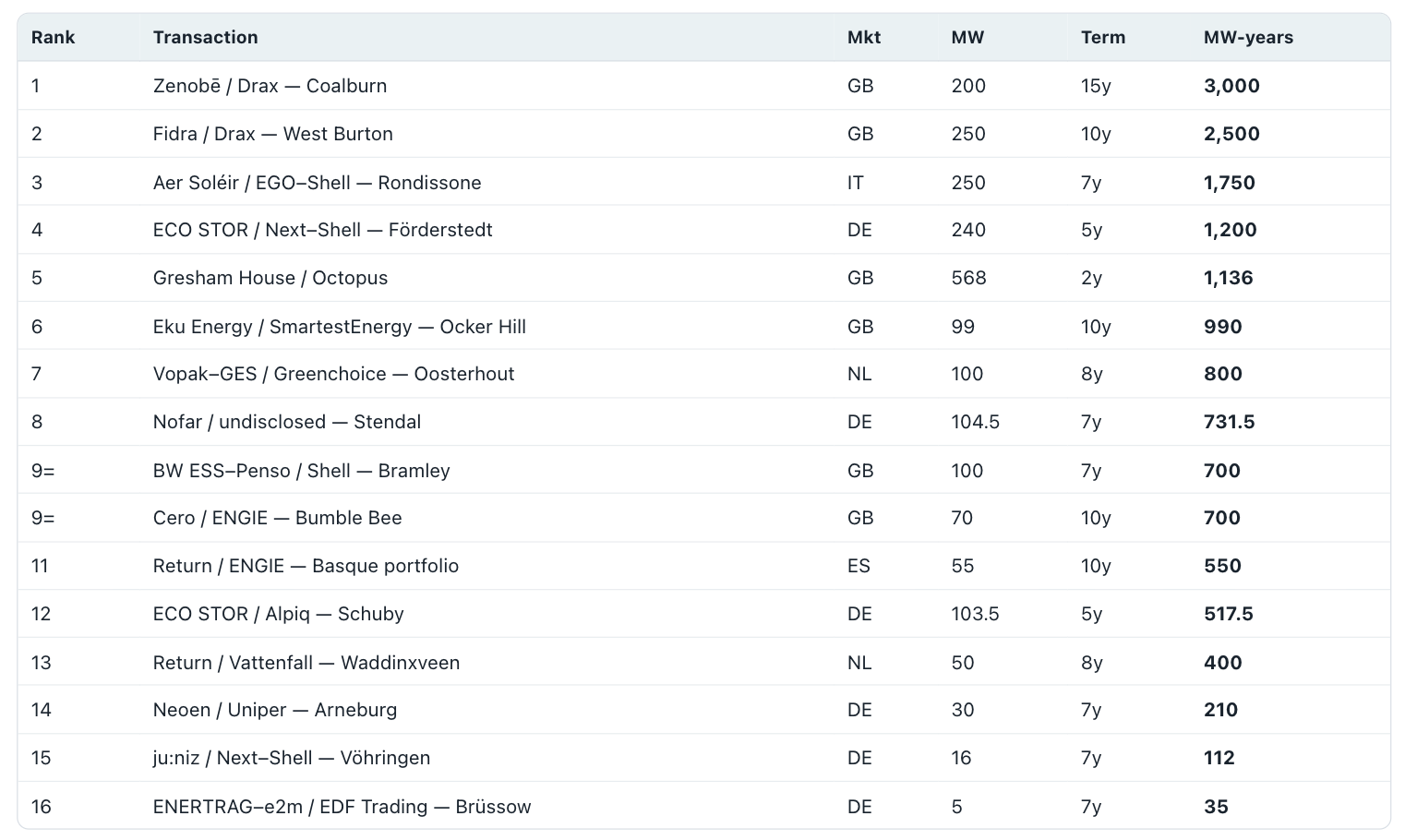
The Drax agreements are the clearest examples of conventional physical tolls. For Coalburn, Drax pays a fixed annual fee and receives full operational control and dispatch rights, while Zenobē remains responsible for construction, maintenance and availability. West Burton follows the same broad model.
The Next Kraftwerke–Shell structures are partial rather than full tolls. At Förderstedt, the contract covers 80% of the 300 MW project for five years, for example.
Gresham House’s two-year Octopus agreement is large in MW terms but short compared with the Drax contracts. Capacity Market revenues remain with Gresham. A toll can be revenue-stream specific.
Substantial tolls that remain unranked
Zelestra / EnBW — Emilia-Romagna
https://www.enbw.com/press/enbw-zelestra-bess-italy.htmlGIGA Storage / Vattenfall — Project Leopard
https://group.vattenfall.com/press-and-media/newsroom/2025/vattenfall-signs-landmark-battery-storage-agreement
These could be some of Europe’s larger tolls by MW-years, but I don’t know the term. Let me know if you do!
Physical tolls are the most visible part of the market, but perhaps not the most interesting. The next structures separate flexibility, downside protection and power-price volatility from the physical battery itself.
