
Advanced Classifier
New Developments I.

Perhaps progress today is less about solving problems and more about building unexpected loops around them. In that sense it begins to resemble performance art. The people to study might be Tehching Hsieh, Marina Abramović, or Joseph Beuys. The task is to construct a practice that can be iterated through taste, attention, and motivation. What ultimately matters is the question: it must be interesting enough to keep the loop running.
“The idea becomes a machine that makes the art.” — Sol LeWitt
In a small way, Stratnergy itself is becoming such a loop. The regime classifier is one example: a tool that keeps asking the same question of the market day after day — not “what happened?” but “what state are we in?”
This is the first in a short series on recent Stratnergy updates. The features have developed faster than I expected, and one thing is becoming clearer: the writing and the code are starting to push each other forward. Analysis turns into tools; tools in turn change what we think is worth writing about.
There is a lot of market commentary around, but much of it does the same thing: it tells you what just happened.
Cue the inevitable LinkedIn post about a price spike. That is useful up to a point. But if you follow things seriously, you’ll usually want something slightly different.
Where is the market now?
How stable is that view?
What should have my attention next?
That defines the job for the regime classifier, which has developed significantly since the last post.
Instead of giving you only a daily adjective, the new regime feature starts to answer a better set of questions:
What state does the market appear to be in?
How stable is that state?
What nearby states or risks should you be watching?
A live example: Wednesday to Thursday
Real examples are important. Let me know if it reveals mistakes I haven’t caught…
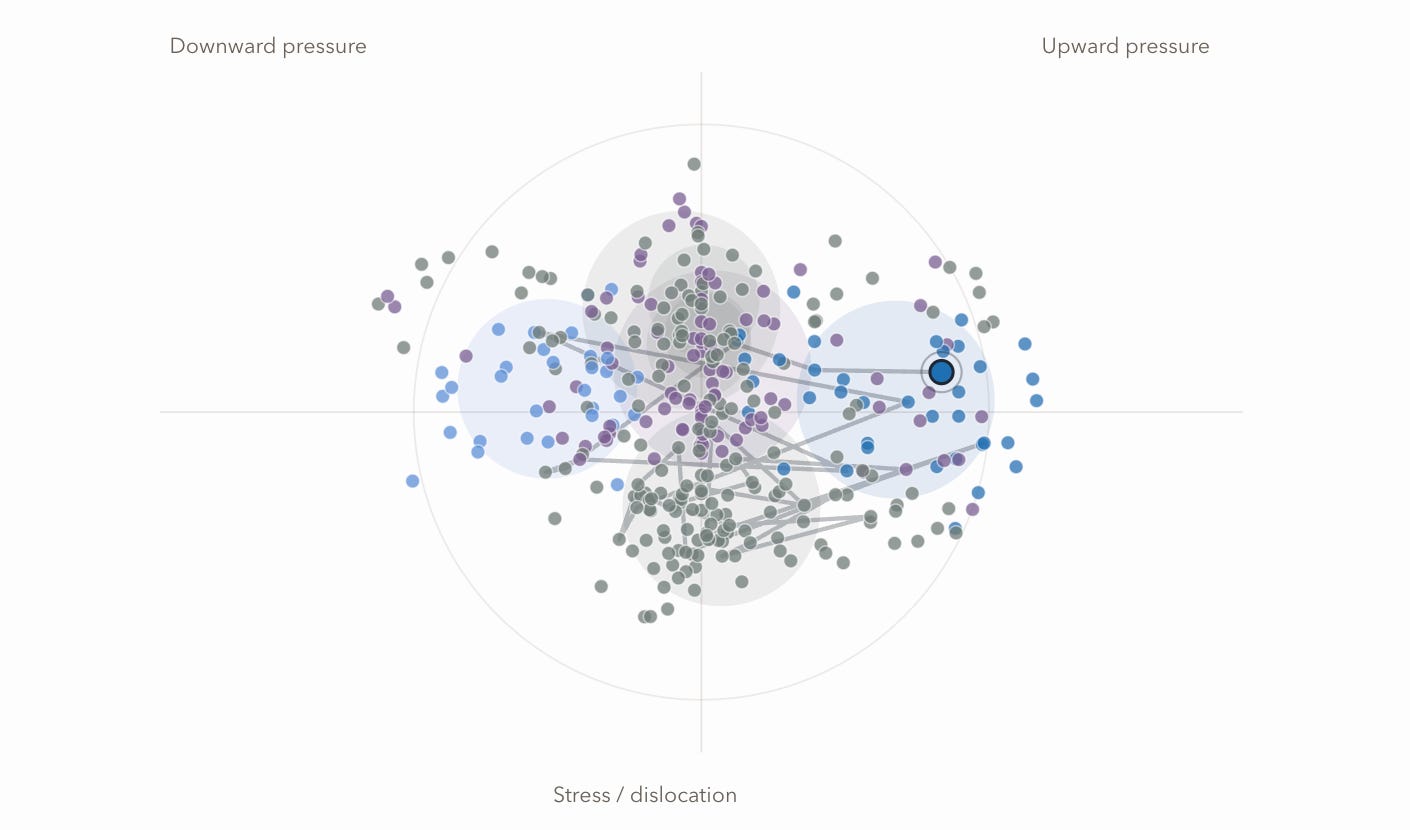
As I write this on Wednesday, March 4, 2026, the observed regime is the “Upward Shape Pressure” regime. The strongest live signal sits in the late-day upward correction need. The top aFRR+ block is 16-20 at EUR 54.00, day-ahead spread for the observed surface is EUR 404.2/MWh, and the current winner beats the “surprise dislocation” regime by a healthy margin.
So today has a relatively clear position.
But the interesting part is what the model says next. The published next-day preview for Thursday, March 5, 2026 rotates to the “mixed transition” regime.
That is not because the market gets calmer. Almost the opposite. Tomorrow’s surface lights up several things at once. Midday points strongly toward downward pressure, reserve and tightness are both elevated (the 12-16 block carries aFRR- at EUR 65.00 and FCR at EUR 97.09), and the evening still carries visible upward correction need (16-20 block still shows aFRR+ at EUR 47.87).
In other words, the market is no longer cleanly one-sided. Several candidate states are active together. “Mixed Transition” only beats “Downward Shape Pressure” by a very thin margin.
The regime explorer is doing something slightly different from traditional commentary. It helps locate the market in a broader state space: what the nearest neighbours look like, whether the current state sits in a stable pocket, and whether the surrounding terrain looks familiar or fragile.
That is exactly the kind of thing a companion site can do better than a newsletter post. The regime object stays live and becomes useful day after day.
The site is becoming a place you can open for quick orientation before diving into the details.

What to watch tomorrow…
The midday 12-16 block. aFRR- at EUR 65.00 and FCR at EUR 97.09 make that the clearest downward-pressure candidate in the published surface.
The evening 16-20 block. aFRR+ at EUR 47.87 means upward correction need does not disappear just because midday gets heavier on the negative side.
Whether the market resolves or stays mixed. Tomorrow could either settle into a cleaner downward state or stay stuck in a transition zone.
The last version tested some market state descriptors. Interesting and useful, a bit like wine tasting notes. But as with wine, I think it’s essential to have a system behind the language. So, what’s the system here?
